Cracks, Shifts, and Sinking Values: The Foundation Problems That Blindside Tiny Home Buyers
Buying a tiny home feels like a straightforward transaction compared to purchasing a conventional house. Smaller structure, simpler systems, less to go wrong—right? That's the assumption a lot of buyers carry into the process. And it's the assumption that gets them into trouble when, two years in, the door stops latching properly, a crack appears along the roofline, and an inspector delivers news that nobody wants to hear.
Foundation and structural movement is one of the most consequential—and most overlooked—risks in the tiny home market. It affects homes on wheels, homes on piers, and homes on permanent slabs. And when it happens, it doesn't just make your home uncomfortable to live in. It can make it nearly impossible to sell.
Why Tiny Homes Are Structurally Different—and More Vulnerable
Conventional home construction benefits from redundancy. Large structural members, multiple load paths, and significant dead weight all work together to resist movement and distribute stress. Tiny homes, by design, use lighter materials, smaller framing members, and—in the case of THOWs—trailer chassis that flex and move as part of their normal function on the road.
When a tiny home on wheels transitions from a mobile life to a semi-permanent parked existence, that chassis was designed to flex under dynamic road loads, not to serve as a static foundation. Over time, without proper support blocking and leveling, the chassis can rack or warp. The structure above it follows.
Permanently sited tiny homes on concrete piers face a different version of the same problem. Pier foundations are economical and common in the tiny home world, but they're highly sensitive to soil conditions. In areas with expansive clay soils—common across Texas, Oklahoma, and much of the South—piers can heave seasonally as the ground swells and contracts with moisture changes. In freeze-thaw climates, inadequately deep piers can be pushed upward by frost action every winter.
Slab foundations, while more stable, aren't immune either. Improperly prepared subgrades, poor drainage, and tree root intrusion can all cause differential settling that cracks a slab and distorts the structure above it.
The Inspection Gap Nobody Talks About
Here's where tiny home buyers get into real trouble: the inspection process for tiny homes is genuinely inconsistent across the country, and the regulatory frameworks that govern it are a patchwork.
In most states, a traditional home inspection is performed by a licensed home inspector working to a defined standard of practice—typically aligned with ASHI or InterNACHI guidelines. These standards were written for conventional residential construction. They don't always translate cleanly to tiny homes, particularly THOWs, which may technically be classified as RVs under state law.
If your tiny home is classified as an RV, a conventional home inspector may not be legally permitted to inspect it—or may not have the training to do so competently. RV inspectors, on the other hand, are often more focused on mechanical systems and less experienced with structural framing and foundation issues.
The result is a gap. Buyers hire whoever is available, get a report that misses the structural nuances specific to their home type, and walk into ownership with problems that were present at purchase but never flagged.
"I had two inspectors look at my tiny home before I bought it," says Dani, who purchased a pier-set tiny home in North Carolina. "Neither one of them checked the piers individually. Six months later, two of them had sunk almost two inches on one side. The whole floor had a noticeable slope."
Correcting the pier problem cost Dani over $4,000—not including the interior repairs needed after the settling distorted her door frames and cracked her wall panels.
Red Flags Buyers Should Demand Inspectors Address
If you're purchasing a tiny home—or if you own one and haven't had a thorough structural review—here are the specific issues that should be on every inspection checklist.
For THOWs and trailer-based homes:
- Inspect the trailer chassis for rust, cracks at weld points, and deformation. A chassis that has flexed excessively may have compromised the structural connection points between the trailer and the home's framing.
- Check that the home is properly blocked and leveled, with support distributed across multiple points rather than resting solely on the hitch and rear axles.
- Look for racking in the wall framing—doors and windows that don't operate smoothly are often the first sign that the structure has moved out of square.
For pier-set tiny homes:
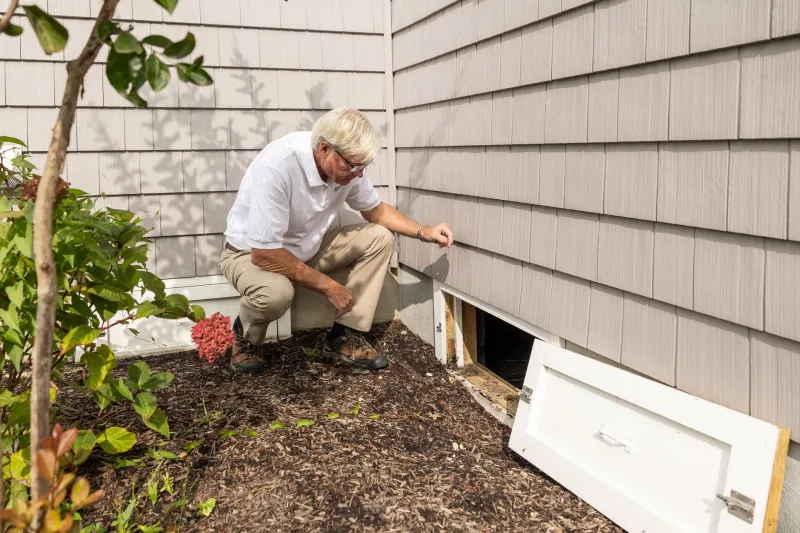
- Each pier should be individually inspected for settlement, heaving, or lateral movement. Don't accept a visual-only check from ground level.
- Check the beam-to-pier connections. In a settled pier situation, the beam may have separated from the pier cap, leaving the structure partially unsupported.
- Look for diagonal cracking at window and door corners on the interior—this is a classic indicator of differential settlement.
For slab-founded tiny homes:
- Look for cracks in the slab itself, particularly diagonal cracks that suggest differential movement rather than simple shrinkage.
- Check exterior grade drainage. Water pooling against the foundation is one of the primary causes of slab movement over time.
- Inspect the perimeter of the slab for separation between the slab edge and the soil, which can indicate washout or erosion undermining the slab.
What Foundation Problems Do to Resale Value
Beyond the livability issues—sloping floors, sticking doors, cracked finishes—structural movement creates a resale problem that's genuinely difficult to overcome.
Buyers and their agents are increasingly sophisticated about tiny home risks. A disclosed foundation issue, even one that's been repaired, will trigger price negotiations and sometimes walk-aways. An undisclosed issue that surfaces during inspection can collapse a deal entirely.
More significantly, many lenders who are already reluctant to finance tiny homes will not touch a property with any documented structural history. If your buyer needs financing—and most do—a foundation problem can effectively remove you from a large portion of the potential buyer pool.
From a permitting standpoint, some jurisdictions are now requiring structural inspections before issuing certificates of occupancy for permanently sited tiny homes. If your home has settling issues that don't meet local structural standards, you may not be able to legally occupy it—or transfer it to a new owner—without remediation.
Prevention Is Dramatically Cheaper Than the Alternative
The best time to address foundation vulnerability is before you buy, and the second-best time is right now—before problems compound.
For THOW owners planning to stay put for more than a year, investing in proper blocking and leveling—and checking it seasonally—is cheap insurance. Pier-set home owners should walk their pier lines after every significant rain event and after freeze-thaw cycles, looking for any visible movement.
For buyers, the lesson is simple but often skipped: hire a structural engineer, not just a general inspector, to evaluate any tiny home before purchase. Yes, it costs more. Yes, it's worth it. A few hundred dollars in professional evaluation is a small price compared to discovering that the home you just bought is slowly pulling itself apart.
Tiny homes are built to be smart, efficient, and resilient. But resilience requires a solid foundation—literally. Don't skip the step that makes everything else possible.